
Latest News and Updates
San Miguel Foods breaks ground for mega poultry plant in Davao to bolster food security
San Miguel Foods recently broke ground on its Davao Multi-Tier Broiler Farm, the first of 15 poultry mega plants the company is building in the next 10 years to ensure the sufficient supply of chicken and bolster food security in the country. Located in Hagonoy, Davao City, the complex will eventually house 28 world class climate-controlled farm houses that will produce 80 million birds a year to serve the whole of Mindanao. Total land to be developed is 921 hectares.
“Today, we are not just breaking ground but also marking another milestone in the food industry,” said San Miguel Foods President Butch Alejo in his message during the ceremony. “What we are bringing to the table is not just a significant amount of chicken that our consumers can enjoy, but also the assurance of food security to every Filipino.”
The broiler farm will have multi-tier cages that will allow more growing cycles per year and better efficiencies and practices, including an integrated sanitation management program to eliminate flies and neutralize odor.
The establishment of the facility demonstrates San Miguel’s commitment to help achieve equitable development in the region. Aside from providing more than 1,000 jobs to the Davaoeños, micro-enterprise programs will open for farmers, their families, and communities nearby. This will spur not just socio-economic growth of the entire municipality but also provide hope for the families nearby, who, with the substantial opportunities given them, can gain more access to technology, education, and sustainability.
Mindanao is considered the country’s food basket, producing 40% of the country’s food needs and contributing more than 30% to national food trade, with one-third of its land area devoted to agriculture.
Within the next five years, San Miguel Foods will begin work on the four other priority mega plants in Sison, Pangasinan, Lucanin, Bataan, and Sariaya and Pagbilao in Quezon. In 10 years, these four mega plants combined with the Hagonoy complex will be able to produce 400 million birds a year, with each bird targeted to weigh 2.5kg./ https://www.sanmiguelfoods.com/san-miguel-foods-breaks-ground-for-mega-poultry-plant-in-davao-to-bolster-food-security
News Article 2
Volume of Poultry Production in Central Luzon January to March 2023
Reference Number: 2023-SRLP-Q12023-074
Release Date: Thursday, June 22, 2023
Central Luzon Consistently Topped Chicken Production in the Country
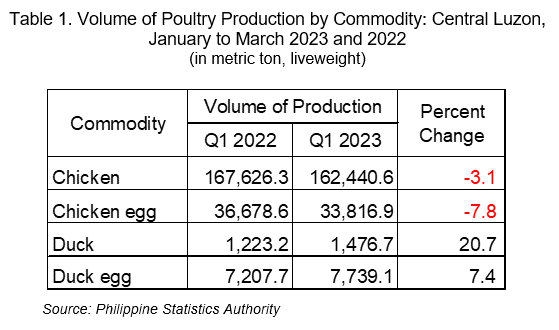
⦁ From January to March 2023, the total volume of chicken production in Central Luzon was registered at 162,440.6 metric tons, liveweight. It decreased by 5,185.7 metric tons from the 2022 first quarter’s production of 167,626.3 metric tons. The noted decline was equivalent to 3.1 percent. (Refer to Table 1)
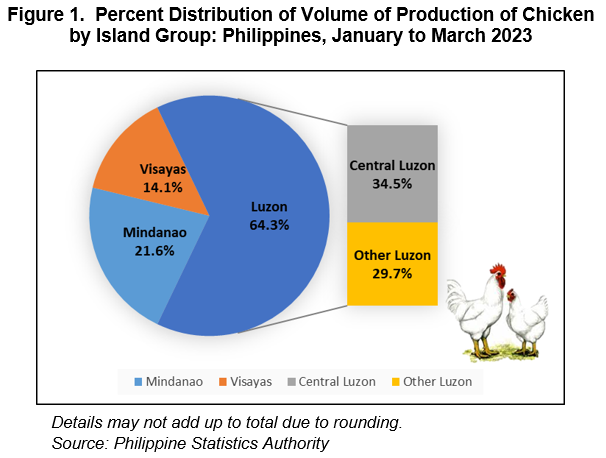
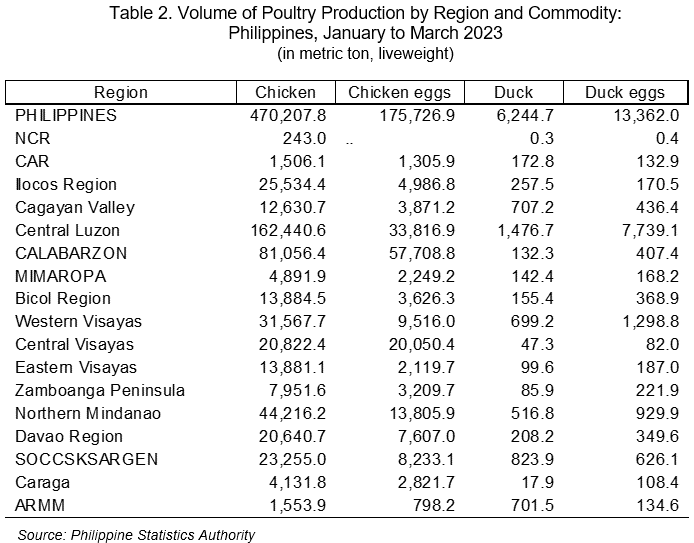
⦁ Across the country, Central Luzon remained to be the top producer of chicken, it contributed more than one third of the national production. The region’s output comprised the 34.5 percent of the country’s chicken production. CALABARZON ranked second at 81,056.4 metric tons which accounted 17.2 percent share. Third in rank was Northern Mindanao at 44,216.2 metric tons, its contribution to the national level’s output was 9.4 percent. (Refer to Figure 1 and Table 2)/ https://rsso03.psa.gov.ph/article/volume-poultry-production-central-luzon-january-march-2023
Central Luzon Remained the Highest Duck-Producing Region
⦁ The Central Luzon’s total duck production in the first quarter of 2023 was registered at 1,476.7 metric tons. It grew by 253.5 metric tons (20.7%) compared to the 1,223.2 metric tons first quarter of 2022 production. (Refer to Table 1)
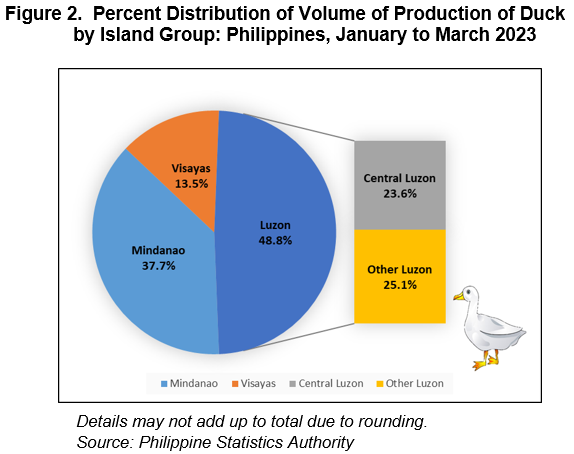
⦁ Among the regions, Central Luzon continued to be the highest duck-producing region in the country. The region’s share was recorded at 23.6 percent followed by SOCCSKSARGEN at 823.9 metric tons (13.2%). Cagayan Valley ranked third at 707.2 metric tons (11.3%) produced. (Refer to Figure 2 and Table 2)
Central Luzon’s Chicken Egg-Production Decreased by 7.8 Percent
⦁ In the first quarter of 2023, the total chicken egg production in Central Luzon was reported at 33,816.9 metric tons. The decline was 2,861.8 metric tons (7.8%) compared to the 36,678.6 metric tons produce in the same period in 2022. (Refer to Table 1)
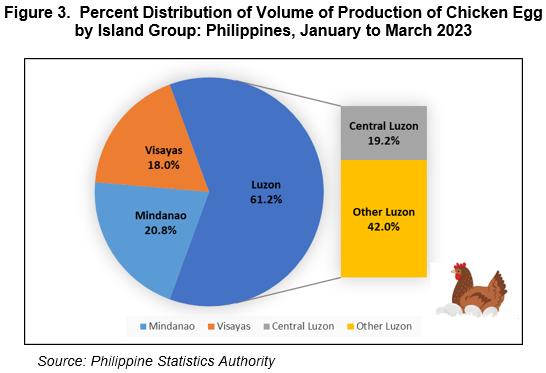
⦁ At the national level, the highest chicken egg-producing region this quarter was CALABARZON at 57,708.8 metric tons. Its contribution to the total chicken egg production was recorded at 32.8 percent. Central Luzon followed at 19.2 percent and Central Visayas at 11.4 percent. (Refer to Figure 3 and Table 2)
Central Luzon Remained the Top Duck Egg-Producing Region
⦁ From January to March 2023, the total volume of duck egg production in Central Luzon was recorded at 7,739.1 metric tons. It increased by
531.4 metric tons than the production in the same quarter of 2022 or an equivalent percent increase of 7.4 percent. (Refer to Table 1)
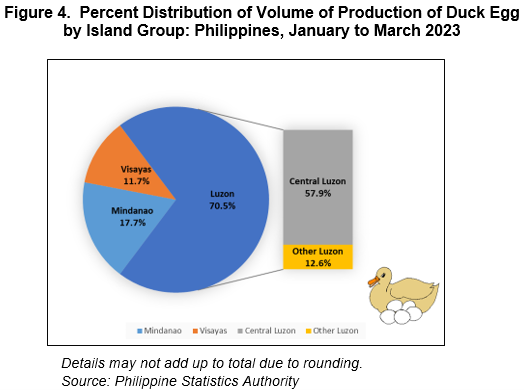
⦁ Among the regions, Central Luzon recorded the top duck egg-producer in the country during the first quarter of 2023. More than half (57.9%) of the national output of 13,362.0 metric tons was supplied by the Central Luzon. Western Visayas registered the second highest production at
1,298.8 metric tons. Third in rank was Northern Mindanao at 7.0 percent share or 929.9 metric tons in January to March 2023. (Refer to Table 2)

STATISTICAL TABLE
TECHNICAL NOTES
VOLUME OF POULTRY PRODUCTION
This Special Release presents the data on volume of poultry production for January to March 2023 from the Backyard Livestock and Poultry Survey (BLPS) and Commercial Livestock and Poultry Survey (CLPS) in Central Luzon. Data are presented at the regional level by commodity in Table 1. Also, data are presented by region and by commodity in Table 2.
The BLPS and CLPS are two (2) major surveys conducted by PSA which aim to generate estimates on inventory, number of animals disposed, average farmgate price, egg production of poultry animals, milk production of dairy animals and other related data at the household level (BLPS) and to estimates on supply, disposition and other related data of livestock and poultry commodities from establishments (CLPS).

Definition of Terms
Volume of Production (operational definition) – the number of tended/raised animals disposed for slaughter including animals shipped-out for slaughter (in “head/bird” and in “liveweight equivalent”).
Poultry – a collective term for all domesticated avian for the purpose of food consumption or, the carcass of such avian are processed for human consumption from household and establishment.
Backyard farm/raiser – refers to household raising at least one head of animal or bird and does not qualify as an establishment.
Animal Population (also Animal Inventory) – the actual number of animals (in head/bird) present in the household (BLPS) or establishment (CLPS) as of a specific reference date regardless of ownership.
Household – A person or group of persons who sleep under the same dwelling unit and usually have a common arrangement in the preparation and consumption of food.
Establishment – an economic unit which engages under a single ownership or control, i.e., under a single legal entity; in one or predominantly one kind of economic activity at a single fixed physical location. Thus, stores, shops, factories, mining companies, electric plants, transport companies, radio stations, hotels, restaurants, banks, insurance companies, real estate development companies and the like are considered establishments. For this survey, L&P establishments are establishments engaged in the raising (farming) and breeding of livestock and poultry animals in an establishment. Also, traders such as assemblers, distributors, etc. will be excluded in the survey.
Liveweight – the body weight of live animals disposed for slaughter.
News Article 3
PH chicken output to improve this year
By: Alden M. Monzon – @inquirerdotnet
Philippine Daily Inquirer / 02:22 AM February 02, 2023
MANILA, Philippines — The local broiler chicken inustry expects to produce around 1.72 billion kilograms of dressed chicken this year, slightly higher than last year’s level, despite continuing challenges such as high cost of feed and continuing avian flu threat.
United Broiler Raisers Association (Ubra) president Bong Inciong told this to the Inquirer on Wednesday, estimating local production of one of the most consumed meat in the Philippines to top last year’s output by about 65 to 75 million kilograms.
“Compared with last year, it will be more by about two weeks’ worth of supply,” Inciong said. However, he noted this was but a conservative estimate of industry output.
The Ubra official noted there were around eight big-time conglomerates in the local broiler industry, citing Filipino companies such as the San Miguel Corp. and the Bounty Fresh Group of Companies.
Inciong also mentioned the local operations of Charoen Pokphand Group, a conglomerate based in Thailand that is one of the largest industry players around the globe.
Other key players are China’s New Hope Group, American conglomerate Cargill, as well as other companies from Taiwan, South Korea and Malaysia.
“There’s great competition there. But they just import the breeders on the assumption that they’re efficient and they can compete even if it leads to lower prices. They have the capital to cushion that,” said Inciong.
“The price [of dressed chicken] is actually going down. If you look at the prices this month of January, it has gone down by about P25,” he adds.
According to the market monitoring of the Department of Agriculture, fully-dressed whole chicken sells for as low as P160/kilogram (kg) to as much as P200/ kg as of Feb. 1. Despite this positive outlook, Inciong said that they perceive several challenges this year that might stifle the growth of the whole chicken industry.
These, he said, included “high and increasing costs” of feed, which was seen driving up the prices of their products.
“For feeds, we use local corn, which is cheaper than imports. But local corn producers cut their production because of what happened to the swine industry. It’s a large market for them and since it contracted, they lessened their production,” said the Ubra official.
He added that rising logistics cost is also a major challenge and consideration for them, citing in particular that freight costs have almost doubled in recent times./Alden M. Monzon – @inquirerdotnet
Philippine Daily Inquirer https://business.inquirer.net/384685/ph-chicken-output-to-improve-this-year